The Reclining Buddha is the obvious first stop at Wat Pho, but it is not the whole temple. The ordination hall and the four large royal chedis give the visit a different scale and purpose. Wat Pho works particularly well as a focused old-town outing: arrive by the appropriate street or river approach, understand which hall you are entering, then decide whether a second temple still fits the day.
Find the reclining Buddha hall within the larger temple
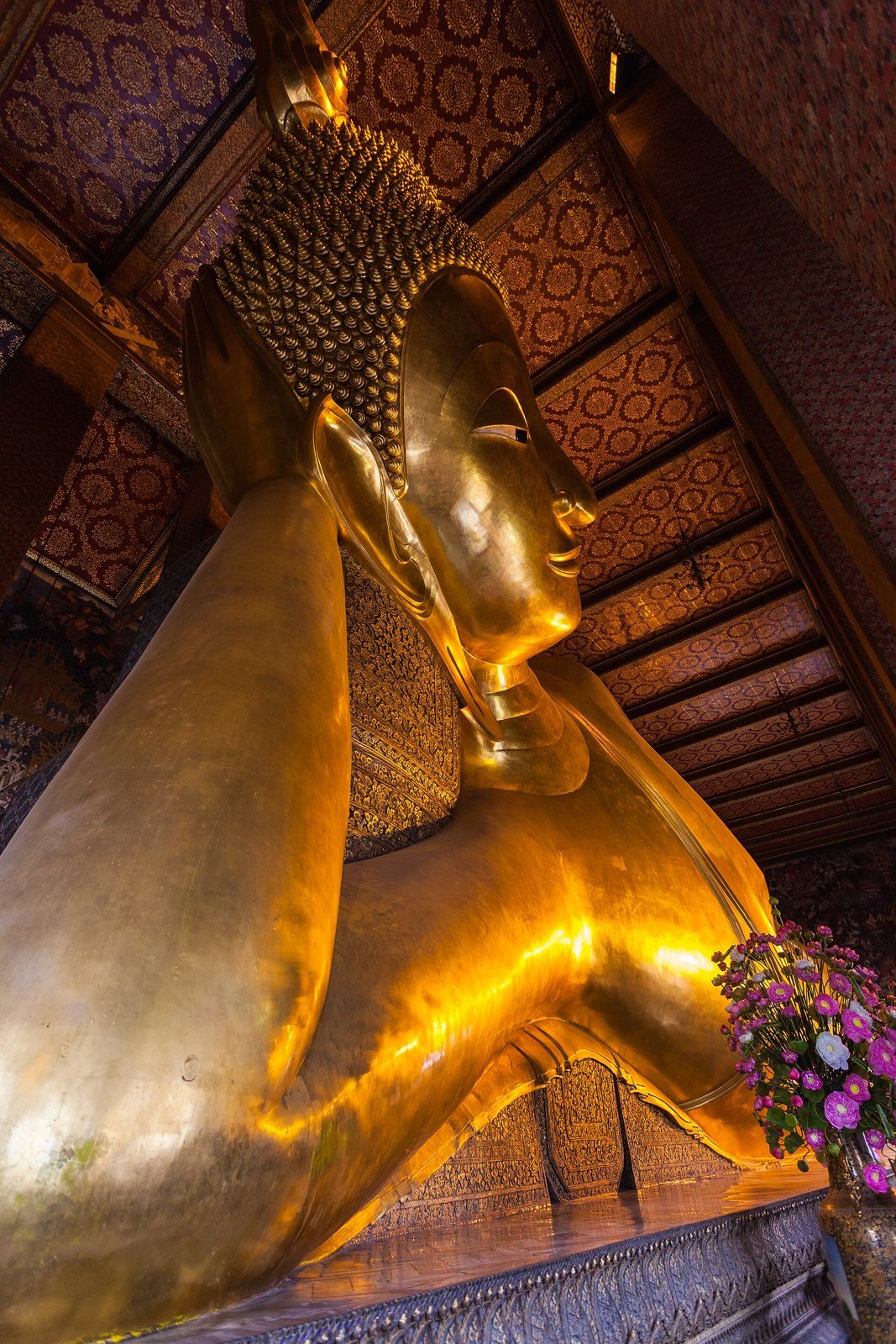
The temple’s own account describes the reclining image as 46 metres long and 15 metres high, made with brick and stucco under lacquer and gilding. Its hall sits in the northwestern part of the monastic area. Those proportions explain the familiar long view, but the feet deserve a separate look: their mother-of-pearl decoration presents 108 auspicious symbols.
The symbols are not simply repeated floral decoration. Wat Pho groups them into themes including fortune, royal attributes and Buddhist cosmology. Look at the sole as a composed religious image rather than just the end of an enormous statue. Keep the circulation route clear while stopping to examine the detail, especially if other visitors are moving through the same hall.
Continue to the ordination hall and the royal chedis
Phra Ubosot, the ordination hall, centres on the seated Phra Buddha Theva Patimakorn. The temple identifies mother-of-pearl door panels showing Ramakian episodes, with different ecclesiastical imagery on their inner sides. This is a useful contrast with the reclining Buddha hall: the interest shifts from the length of one image to the relationship between an altar, doorways and painted surfaces.
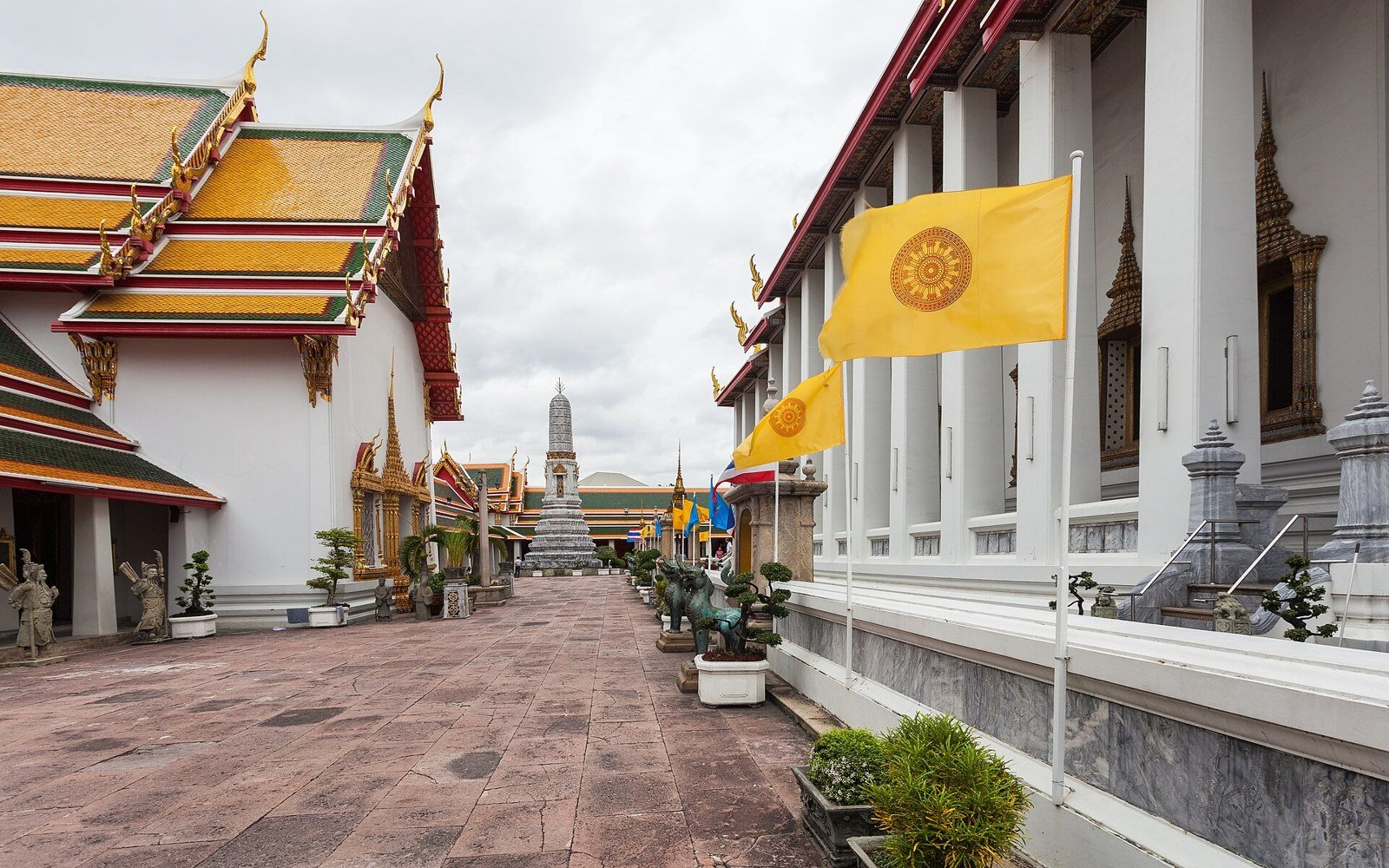
The four Phra Maha Chedi Si Rajakarn form another distinct group. Wat Pho associates their coloured mosaics with the first four kings of the Chakri dynasty: green for Rama I, white for Rama II, yellow for Rama III and dark blue for Rama IV. The four stand within a shared enclosure. Their differences become much easier to notice when treated as one group rather than four unrelated towers.
A practical editorial circuit is the reclining Buddha hall, the royal chedi group and the ordination hall, following whichever paths are open. Use the temple plan to orient that circuit rather than cutting through spaces reserved for religious activity. A change in the order of visits is preferable to interrupting a service to keep to an itinerary.
Admission and the limits of the published hours
Wat Pho’s visitor-plan page lists admission at 300 baht, with free entry for children under 120 centimetres in height. It gives operating hours of 08:00–19:30. The official homepage footer, however, starts the day at 08:30. If a very early arrival matters, confirm that detail with the temple; an arrival after 08:30 avoids depending on the earlier figure.
Do not assume that the general closing hour guarantees access to every hall or a late appointment for another service. A temple visit and a massage booking are separate activities. Check the area or service you specifically need, particularly if the day is already being shaped around another attraction’s last admission.
The Grand Palace ticket does not cover Wat Pho. They are neighbouring compounds with their own visitor arrangements. Keep that distinction clear when comparing a guided package, an independent temple visit and a river transport ticket: each may cover a different part of the day.
Choose the street approach before the river crossing
Wat Pho gives its address as 2 Sanam Chai Road in Phra Nakhon, beside the Grand Palace area. BEM identifies Sanam Chai on the MRT Blue Line and lists exit 1 for Wat Pho and Museum Siam. Use that station name when planning a rail journey; Wat Pho is the destination, not the formal name of a separate MRT station.
Tha Tien is the river-side reference point for the temple area. The boat operator’s current route information includes Tha Tien and Wat Arun, but the cross-river ferry and a through-running tourist boat should not be treated as the same service. Check where your chosen boat actually stops and which bank you need before boarding.
If staying on the Thonburi side, the crossing becomes part of the Wat Pho visit. If staying near Tha Tien on the Phra Nakhon bank, it may instead be part of the onward journey to Wat Arun. This difference is worth more than an accommodation listing that merely says “near the river”.
Clothes, shoes and a place of worship
The temple asks visitors to dress politely and remove shoes where required before entering religious buildings. Choose clothing that covers shoulders and knees and follow the instructions for each hall. Keep the designated shoe area and doorway usable for other people rather than treating the entrance as a place to reorganise the whole visit.
Wat Pho also asks for quiet, respectful conduct around rites and monks. Photography does not give permission to climb, touch or use a Buddha image as a prop. Observe posted restrictions and the needs of worshippers in the particular space. The reclining Buddha and the ordination hall can involve different visitor flows even within one ticketed visit.
Keep massage and the second temple optional
The traditional medical school is a genuine part of Wat Pho’s identity, and the temple visitor page links to its massage service. Admission to the temple is not a treatment reservation. Anyone wanting a session should confirm the provider’s current arrangements directly and leave enough flexibility for the actual appointment rather than building a guaranteed treatment into a tightly timed sightseeing circuit.
An editorial half-day plan is to give Wat Pho the first part of the visit, take a break in the Tha Tien area, then decide whether to cross to Wat Arun. If the Grand Palace is also essential, its ticket window and ceremony calendar may determine the sequence. The temples are close in the visitor’s mental map, but separate entrances, worship and boat movements still take time.
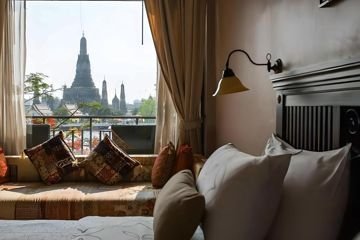
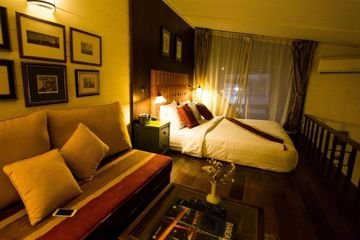
For a hotel base, compare Tha Tien or the wider old-town setting with a rail-connected property farther away. Look at the actual walk or transfer to Sanam Chai, not a straight-line distance alone. A waterfront room can be attractive for the outlook while putting the hotel on the opposite bank from Wat Pho.
Sources & further reading
Sources checked on 29 October 2026. Confirm current visiting arrangements and ceremony notices before setting out.